Choosing Gutters for Ranch-Style Homes in Silver Lake, Florida
Ranch-style homes and gutters make an interesting pair in Central Florida. On paper, a ranch house looks simple to drain. The roofline is usually low, the footprint is spread out, and access is easier than it is on a taller home. In practice, that long horizontal shape creates its own challenges. You may have wide roof runs that collect a lot of water in a summer storm, long eaves that need a clean visual line, and outdoor spaces, lanais, or pool enclosures that turn a basic downspout decision into a landscaping and drainage decision.
In Silver Lake, where heavy rain, humidity, and regular stormwater issues are part of normal home maintenance, choosing gutters is less about decoration and more about control. Good gutters help you decide where roof water goes. That matters because runoff that dumps next to the house can lead to pooling, erosion, and pest problems, and it can make outdoor areas muddy and unpleasant fast. Florida-friendly guidance consistently points homeowners toward sending roof runoff to places that can absorb it, such as lawn areas, planting beds, rain gardens, cisterns, or other pervious ground. That principle should shape every gutter decision you make, from the profile you choose to where each downspout ends.
Why ranch homes need a slightly different approach
A ranch home often has a generous roof perimeter. Even when the roof is not especially steep, a thunderstorm can push a surprising amount of water off a long eave. The lower height of the house makes cleaning and inspection easier, but it also tempts people to treat gutter planning as an afterthought. That is usually where problems start.
What I see most often with single-story homes is not dramatic failure. It is smaller issues that repeat over time. Water splashes too close to the foundation. One downspout empties beside a walkway and creates algae or a slick spot. A bed along the front of the house gets hammered every storm and loses mulch. If there is a screened pool area, one corner becomes the default dumping point for runoff because it was the easiest place to terminate a line during installation. None of those problems look severe on day one. A Florida rainy season changes that.
The shape of many ranch homes also means you are making gutter choices across a long visible frontage. On a house with a low profile, gutters are not hidden much by the roofline. They read as part of the trim. So the best choice has to do two jobs at once. It has to manage water well, and it has to look deliberate rather than tacked on.
Start with drainage, not the gutter profile
Most homeowners begin by asking about style, color, or material. Those matter, but the first real question is where you want the water to go.
UF/IFAS guidance is clear that roof runoff should be directed away from the house and into areas that can absorb water, rather than concentrating it next to the foundation or hard surfaces. That means your downspout plan should come before the final product selection. On a ranch home, that plan is often more flexible than it is on a multi-story house because you have easier access to grade-level drainage paths. That is a real advantage if you use it.
For example, if one side yard drains toward turf and another side yard drains toward a hard-packed path, those two roof edges should not be treated the same way. The first may be a good place to send water onto lawn or into a planted area. The second may need a different termination point so it does not create runoff or erosion where people walk. The same logic applies around patios and pool decks. A simple gutter layout can still fail if every downspout empties where water has nowhere useful to go.
This is where ranch homes reward careful thought. Their low eaves often allow cleaner routing and easier observation during a storm. If you have ever stood outside in a hard rain and watched which corners sheet water and which corners stay manageable, that quick visual inspection tells you more than a catalog ever will.
Seamless or sectional, and why appearance matters on a long roofline
For many ranch homes, seamless gutters make visual sense because the roofline is long and uninterrupted. A continuous look tends to suit the horizontal architecture. It is one reason terms like seamless gutters Williston FL show up so often in homeowner searches, even outside that specific town. People are not just looking for fewer joints. They are reacting to the cleaner line.
That said, the decision should stay grounded. A longer front elevation benefits from a system that looks consistent and does not draw attention to every connection point. On a home where the gutter is plainly visible from the curb, fewer breaks can give the house a tidier, more finished look. That is especially helpful on ranch homes with simple facades, where every trim element counts a little more.
Appearance is not just curb appeal, either. When a gutter line looks crooked, bulky, or mismatched, it can make a low, broad home seem flatter and heavier than it https://homeexteriorguide051.stonefielddigest.com/posts/downspout-drainage-in-newberry-fl-how-to-move-roof-water-away-from-the-foundation really is. A well-proportioned installation does the opposite. It disappears into the architecture.
Picking colors that work in Florida light
Gutter colors for Florida homes deserve more attention than they usually get. Bright sun, high contrast, and open front yards make trim colors more noticeable here than many homeowners expect. On ranch homes, because the eaves are lower and more exposed, the wrong color can feel louder than it did on a sample strip.
Most of the time, the safest path is to match either the fascia or the dominant trim rather than trying to make the gutters stand out. Ranch architecture usually benefits from restraint. If the goal is a clean horizontal line, matching adjacent trim keeps the eye moving across the house instead of stopping at the gutter. If your roof, fascia, and trim are varied, choose the element you want the gutter to visually blend into most.
If you live in a neighborhood with an HOA or architectural review committee, check exterior appearance standards before ordering. In Florida, associations do have authority over exterior appearance standards, including color and style specifications for certain exterior products, though those standards must comply with building code requirements and cannot be used to block installations that otherwise conform. That means color review can be real, even when the drainage need is obvious. It is better to settle that early than to argue after fabrication.
Metal roofs change the conversation a bit
Homeowners searching for gutters for metal roofs Florida are usually trying to solve two problems at once: drainage and compatibility. A metal roof on a ranch home can be a practical pairing in this climate, but the gutter plan still comes back to runoff control and maintenance. The roof material may change how water moves off the roof, but it does not change the basic rule that downspouts need to direct that water away from the house and into absorbent areas where possible.
On low, wide homes with metal roofs, one thing matters a lot in real life: observation. Watch the home during a strong rain after installation. You are looking for overshooting at edges, concentrated discharge at corners, and whether water is ending up on turf, planting beds, or pervious ground as intended. The best design on paper still needs that storm test.
This is also where broad claims can mislead people. There are plenty of gutter myths Florida homeowners hear, especially around roof type, rain volume, and maintenance-free systems. A metal roof does not eliminate the need for gutter upkeep. A single-story roof does not make clogs harmless. A guard system does not excuse ignoring drainage at the ground. In Florida, regular maintenance stays part of the job no matter what product you choose.
Pool cages and outdoor living areas need special planning
Gutter drainage for pool cages is one of those topics that sounds niche until you own the house. Then it becomes very practical. Florida outdoor living spaces are used often, and unmanaged runoff can make them messy, erode adjacent soil, and send water exactly where you do not want it, near screens, decks, walkways, or seating areas.
UF/IFAS guidance around runoff and drainage supports managing roof water carefully so it does not create erosion or persistent overflow problems around outdoor spaces. For ranch homes with lanais or screened enclosures, that means looking beyond the roof edge itself. Ask what happens at ground level in a summer storm. Does the downspout empty beside the cage and create a muddy strip? Does it push water toward a deck edge? Does it wash mulch out from a planting bed that frames the enclosure?
A good gutter layout protects the usability of those spaces. Sometimes the most important choice is not the front elevation at all. It is the less visible side or rear downspout that determines whether the patio stays clean after a storm.
What drives installation cost in Florida
When homeowners ask about gutter installation cost factors Florida, they are often hoping for one simple price rule. There really is not one. Costs usually move based on the length and complexity of the roofline, access, the number and placement of downspouts, how much customization the drainage plan needs, and whether the installer is solving aesthetic concerns along with water control.
A ranch home can be less expensive to access than a taller home, but that does not automatically make it cheap. Long roof edges mean more material. Corners, transitions, and multiple drainage zones add labor. If the house has landscaping, hardscape, or pool features that limit where downspouts can discharge, planning gets more involved. If the best drainage route sends water to lawn or planted areas away from the house, that can affect the scope as well.
This is one place where lowball estimates often disappoint. A very basic quote may cover hanging gutters, but it may not reflect the thought required to keep runoff on site where it can soak in, avoid erosion, and stay clear of foundation areas and outdoor living zones. On a ranch home, the visible simplicity of the roof can hide a lot of decision-making at ground level.
Repair, replacement, and the signs that matter
Not every ranch home needs a full replacement. Sometimes the real need is targeted gutter repair Hawthorne FL style, meaning the sort of practical repair homeowners search for by town name even when the underlying issue is universal. Joints separate, sections sag, drainage paths prove poorly chosen, or recurring clogs expose a flaw in layout.
The signs worth paying attention to are usually easy to spot if you look during or right after rain.
- Water pooling near the foundation or staying soggy beside the house
- Soil erosion, displaced mulch, or splash marks below roof edges
- Overflow near entry walks, patios, or screened outdoor areas
- Visible sagging, leaking joints, or downspouts that dump where water cannot soak in
- Repeat clogging that returns soon after cleaning
Those are not cosmetic annoyances. In Florida conditions, they are clues that runoff is not being controlled well enough.
Cleaning, guards, and the question every homeowner asks
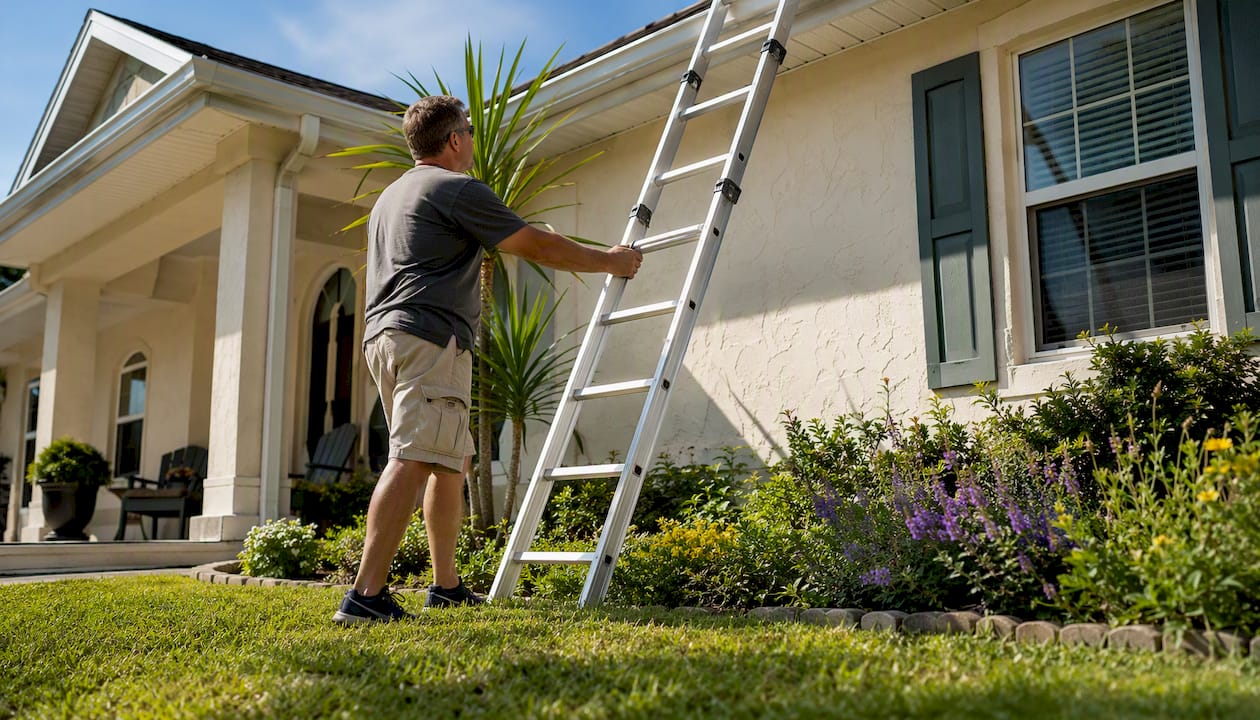
Sooner or later, every gutter conversation turns to maintenance. People want to know whether to handle it themselves, whether to install guards, and whether a one-story ranch home makes it simple enough to forget about.
It usually does not.
UF/IFAS materials note that gutters and downspouts require maintenance because leaves and debris contribute to drainage problems. That is plain, useful advice. A low roof may be easier to reach, but Florida debris still accumulates, and a blocked system still fails at the worst time, usually during heavy rain.
The common question is DIY gutter cleaning or hire a pro. On a ranch home, the honest answer depends on the house, the homeowner, and the condition of the system. If the roofline is straightforward, access is safe, and you are comfortable inspecting downspouts and discharge areas carefully, some owners handle routine cleaning themselves. If there are awkward areas around a screened enclosure, recurring clog problems, or signs of sagging and leaks, hiring a professional is often the better call because cleaning alone may not solve the underlying problem.
Gutter guards can help reduce debris buildup, but they are not a promise of zero maintenance. That is where a lot of disappointment starts. Searches like gutter guards Mount Dora FL reflect real demand, but the best expectation is reduced cleaning frequency, not a permanent end to maintenance. You still need occasional inspection, especially after storms and during periods of heavy leaf drop.
The same goes for location-based searches like gutter cleaning Dunnellon FL. They sound hyperlocal, but they point to a common Florida reality: gutters need regular attention because our weather exposes weak spots quickly.
A practical maintenance rhythm for Silver Lake homes
The easiest gutter systems to live with are the ones you check before they become a problem. Florida weather rewards routine more than heroics. You do not need an elaborate spreadsheet, but you do need a habit.
A useful year-round gutter checklist Florida homeowners can actually stick with looks like this:
- Before the rainy season, clear debris and confirm each downspout sends water away from the house into a pervious area
- After major storms, walk the perimeter and look for overflow, washout, or standing water
- During periods of leaf drop, inspect for buildup even if guards are installed
- Check areas near pool cages, lanais, and walkways for muddy runoff or splashback
- Revisit any spot where water reaches the foundation zone or creates pest-friendly damp areas
That quick walkaround often catches trouble early enough to keep it small.
The myth of the “set it and forget it” gutter system
If there is one idea that causes more trouble than almost any other, it is the belief that a new gutter system ends the conversation for years. That belief shows up in a lot of gutter myths Florida homeowners repeat to each other. It sounds appealing because gutters look static once installed. But the way they perform depends on living conditions that keep changing, storms, debris, landscaping growth, ground settlement, and how outdoor areas are used.
I have seen perfectly respectable installations struggle simply because the downspout discharge made sense in one season and failed in another. A lawn area gets compacted. A bed edge washes out. A corner near the pool becomes the path of least resistance for runoff. None of that means the original product was bad. It means water management needs occasional reassessment.
That is especially true on ranch homes because so much of the drainage story happens where you can see it at ground level. Watch the house in action. If a storm sends water where you would never intentionally pour it from a hose, the gutter plan needs adjustment.
Matching the gutter system to the character of the house
The best gutter choice for a ranch-style home in Silver Lake is usually the one that feels almost invisible in daily life. It should fit the scale of the house, support the long roofline visually, and direct runoff where the landscape can absorb it instead of where it creates headaches.
That means thinking in layers. The architectural layer asks what looks right on a low, horizontal home. The practical layer asks how water moves during a Central Florida downpour. The site layer asks where that water can safely soak in without harming the foundation, lawn, beds, pool areas, or walkways. When those three line up, the gutter system stops being an accessory and starts doing what it is supposed to do quietly.
For most homeowners, that is the real goal. Not the fanciest profile. Not the trendiest add-on. Just a system that respects the house, handles Florida rain sensibly, and keeps your yard and outdoor spaces from paying the price every time a storm rolls through.